
Toughened (Tempered) Safety Glass
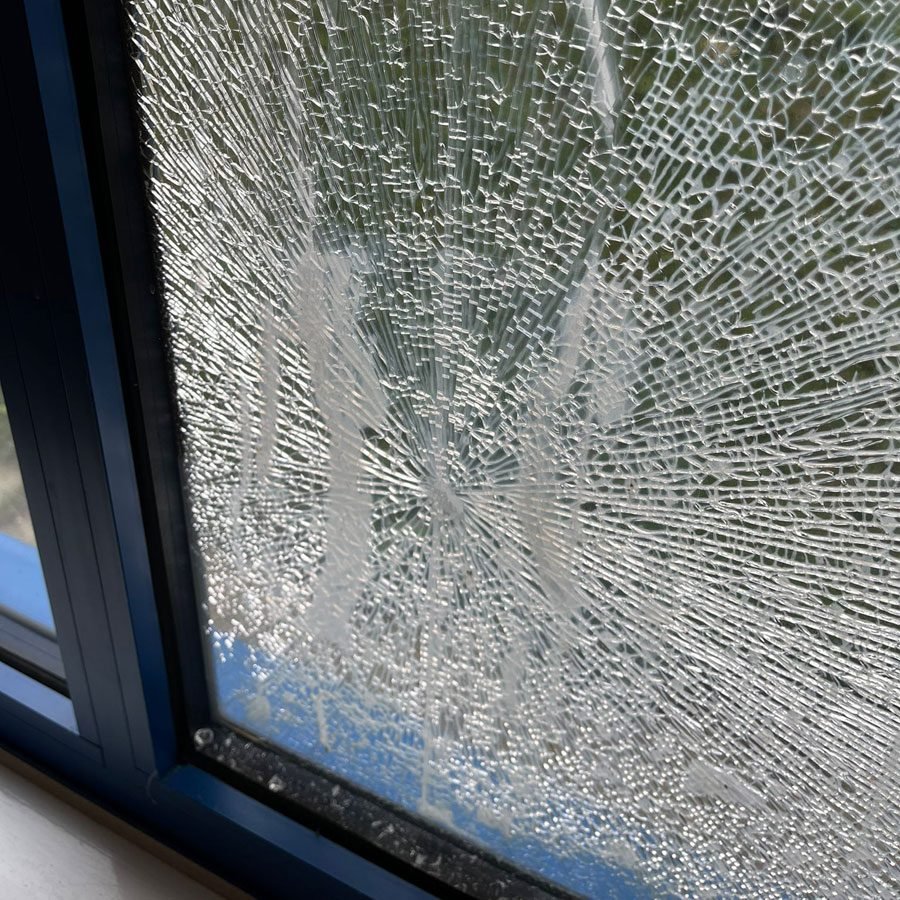
Heat-treated to 620°C then rapidly cooled. 4-5× stronger than annealed. Breaks into small blunt granules rather than dangerous shards — the behaviour that makes it a safety glass. Required by Building Regulations in critical glazing locations.
Toughened — Safety Glass
Toughened glass is produced by heating annealed float glass to ~620°C then rapidly cooling with high-pressure air jets (quenching). This creates permanent compressive stress on both surfaces, making it 4-5× stronger. When broken, it fractures into small, relatively harmless blunt granular pieces rather than sharp shards. Important: toughened glass cannot be cut, drilled or modified after the furnace — all processing must be done before toughening.
Properties Comparison
| Property | Annealed | Heat Strengthened | Toughened |
|---|---|---|---|
| Bending Strength | 40 N/mm² | 70-120 N/mm² | 120-200 N/mm² |
| Thermal Shock | 40°C | 100°C | 200°C |
| Break Pattern | Sharp shards | Large pieces | Small granules |
| Safety Glass? | No | No | Yes (Class 1) |
| Post-Break Barrier | Falls out | Stays in frame | Shatters out |
See how each breaks on impact:
Where Toughened is REQUIRED
- Doors & side panels: Within door leaf or 300mm of edge, floor to 1500mm
- Low-level: Lowest edge below 800mm from floor
- Bathrooms: All glazing in rooms with bath/shower, floor to 1500mm
- Full-height: Floor-to-ceiling panels, glass walls
- Overhead (outer): Outer pane of rooflights
- Near stairs: Staircase enclosures
Heat Soak Testing
Nickel sulphide (NiS) inclusions can very rarely cause spontaneous breakage months/years later. Heat soak testing at 290°C for several hours accelerates NiS expansion, causing affected panels to break in the oven. Recommended for overhead glazing, structural and critical applications.
Cannot Modify After Toughening
All cutting, drilling, holes, notches and edge work must be completed BEFORE toughening. Any attempt to cut toughened glass causes complete shattering.Glass Weight per Thickness
Glass density: 2,500 kg/m³. Weight = Thickness (mm) × 2.5 × Area (m²).
| Thickness | Weight/m² | 600×900 | 1000×1200 | 1500×2000 | Max Sheet | Toughening | Laminating |
|---|---|---|---|---|---|---|---|
| 4mm | 10 kg | 5.4 kg | 12 kg | 30 kg | 3210×2500 | Yes | Yes |
| 6mm | 15 kg | 8.1 kg | 18 kg | 45 kg | 3210×2500 | Yes | Yes |
| 8mm | 20 kg | 10.8 kg | 24 kg | 60 kg | 3210×2500 | Yes | Yes |
| 10mm | 25 kg | 13.5 kg | 30 kg | 75 kg | 3210×2500 | Yes | Yes |
| 12mm | 30 kg | 16.2 kg | 36 kg | 90 kg | 2800×2000 | Yes | Yes |
| 15mm | 37.5 kg | 20.3 kg | 45 kg | 112.5 kg | 2400×1500 | Yes | Yes |
| 19mm | 47.5 kg | 25.7 kg | 57 kg | 142.5 kg | 2000×1200 | Yes | Yes |
Related Products & Glass Types
Common Questions
Get a Trade Quote
Contact our sales team — most quotes returned within 2 hours.