
Self-Cleaning Glass
Permanent photocatalytic TiO₂ coating breaks down organic dirt with UV light. Rain water sheets across the hydrophilic surface washing debris away. Reduces cleaning by up to 80%.
Self-Cleaning — Photocatalytic
Self-cleaning works in two stages: Stage 1 — Photocatalysis: UV from daylight activates TiO₂ coating which chemically breaks down organic dirt. Stage 2 — Hydrophilic sheeting: Rain spreads evenly across the surface (not droplets) washing away broken-down dirt. The coating is pyrolytic (fused during manufacture) — permanent and scratch-resistant.
Watch the self-cleaning cycle in action:
Brand Products
| Product | Brand | Additional | Light | g-value | Application |
|---|---|---|---|---|---|
| Activ™ | Pilkington | Self-clean only | 78% | 0.63 | Rooflights, upper windows |
| Activ™ Suncool 70/35 | Pilkington | + Solar control | 70% | 0.35 | South-facing overhead |
| Activ™ Suncool 50/25 | Pilkington | + Max solar | 50% | 0.25 | High solar exposure |
| Activ™ Optitherm | Pilkington | + Thermal | 78% | 0.63 | Standard self-clean DGU |
| Activ™ Optiphon | Pilkington | + Acoustic | 76% | 0.60 | Noisy + hard to clean |
| Bioclean® | Saint-Gobain | Self-clean only | 77% | 0.63 | Rooflights, facades |
Limitations
- No effect on inorganic: Mortar, paint, mineral staining, hard water marks
- Needs UV: Not effective for permanently shaded north-facing glass
- Needs rain: Sheltered locations may need occasional manual cleaning
- 5-7 day activation: Needs UV exposure to activate after installation
- External only: Does not clean internal face
How the Coating Works
The pyrolytic titanium dioxide (TiO₂) layer is fused onto the glass surface during manufacture, so it becomes part of the glass rather than sitting on top of it. It works in two distinct stages. Photocatalytic breakdown: UV in daylight excites electrons in the coating, which oxidise organic dirt — algae, pollen, exhaust residue — breaking it down into loose, easily-shifted particles. Hydrophilic sheeting: the same coating makes the surface attract water rather than repel it, so rain spreads into a thin, even sheet instead of forming beads. That sheet lifts the broken-down dirt and carries it off in a continuous wash, rather than leaving streaky droplet marks behind.
Where It Earns Its Keep
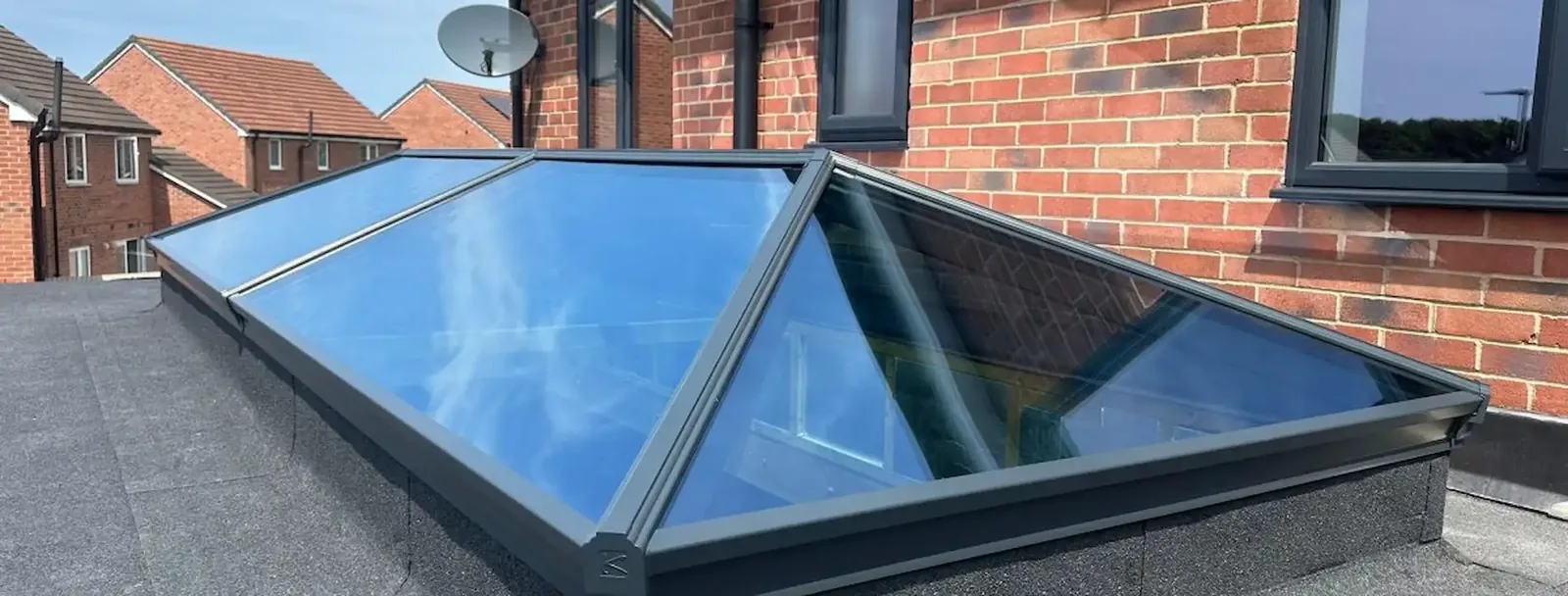
Self-cleaning glass pays for itself fastest wherever manual cleaning is difficult or expensive to arrange — rooflights and conservatory roofs that need scaffolding or a cherry picker to reach, high-level glazing on stairwells and atriums, and facades on upper storeys or over water and landscaping where access is restricted. On low-level, easily-reached glazing the practical benefit is smaller, since a normal clean is quick either way.
Activation After Installation
The coating needs 5-7 days of normal outdoor UV exposure and at least one rain shower to reach full effectiveness after installation. During that window the glass behaves like standard glass; performance builds up rather than switching on immediately.
Pairing with Solar Control in Roof Units
For roof glazing and conservatory roofs, self-cleaning is commonly combined with a solar control coating in the same sealed unit — see the Activ™ Suncool combinations above. This keeps the low-maintenance benefit of self-cleaning on overhead glass that is hard to reach, while the solar coating controls the heat gain that roof glazing is otherwise most exposed to.
Related Products & Glass Types
Common Questions
Get a Trade Quote
Contact our sales team — most quotes returned within 2 hours.