
Solar Control Glass
Advanced coatings reducing solar heat gain while maintaining daylight. Pilkington Suncool™, SGG Cool-Lite®, Guardian SunGuard®. Essential for south/west glazing and Part O compliance.
Solar Control — Heat Rejection
The g-value (solar factor) indicates what proportion of solar energy passes through. A g-value of 0.33 means only 33% of solar heat enters — 67% is rejected. The selectivity index (light ÷ g-value) shows how well light and heat are balanced — higher is better.

Complete Product Range
| Product | Brand | g-value | Light | Ext. Reflect. | U-Val* | Selectivity | Look |
|---|---|---|---|---|---|---|---|
| Suncool™ 66/33 | Pilkington | 0.33 | 66% | 12% | 1.0 | 2.0 | Neutral |
| Suncool™ 50/25 | Pilkington | 0.25 | 50% | 18% | 1.0 | 2.0 | Slight tint |
| Suncool™ 40/22 | Pilkington | 0.22 | 40% | 22% | 1.0 | 1.8 | Blue tint |
| Suncool™ 30/16 | Pilkington | 0.16 | 30% | 28% | 1.0 | 1.9 | Reflective |
| Suncool™ Q 70/40 | Pilkington | 0.40 | 70% | 10% | 1.0 | 1.8 | Ultra-neutral |
| Cool-Lite® ST | Saint-Gobain | 0.32 | 66% | 14% | 1.0 | 2.1 | Neutral |
| Cool-Lite® SKN 176 | Saint-Gobain | 0.42 | 76% | 11% | 1.0 | 1.8 | Very neutral |
| SunGuard® Solar | Guardian | 0.30 | 60% | 15% | 1.0 | 2.0 | Balanced |
| Stopray® Vision 50 | AGC | 0.29 | 50% | 16% | 1.0 | 1.7 | Neutral |
Self-Cleaning + Solar Control Combos
| Product | g-value | Self-Clean | Best For |
|---|---|---|---|
| Activ™ Suncool 70/35 | 0.35 | Yes | Rooflights, conservatory roofs |
| Activ™ Suncool 50/25 | 0.25 | Yes | South-facing overhead |
Part O Compliance (2022)
Part O requires new residential buildings to limit overheating risk. Solar control glass is a primary compliance tool for south/west glazing. We recommend Suncool 66/33 (g=0.33) as a starting point, with Suncool 50/25 (g=0.25) for more demanding situations.
Solar Control vs Clear Float — At a Glance
| g-value | Light Trans. | Heat Rejected vs Clear | |
|---|---|---|---|
| Clear Float (6mm) | ~0.83 | ~89% | Baseline |
| Suncool™ Q 70/40 | 0.40 | 70% | ~52% less solar heat |
| Suncool™ 50/25 | 0.25 | 50% | ~70% less solar heat |
*Typical values, centre-pane basis.
Summer Comfort on South & West Elevations
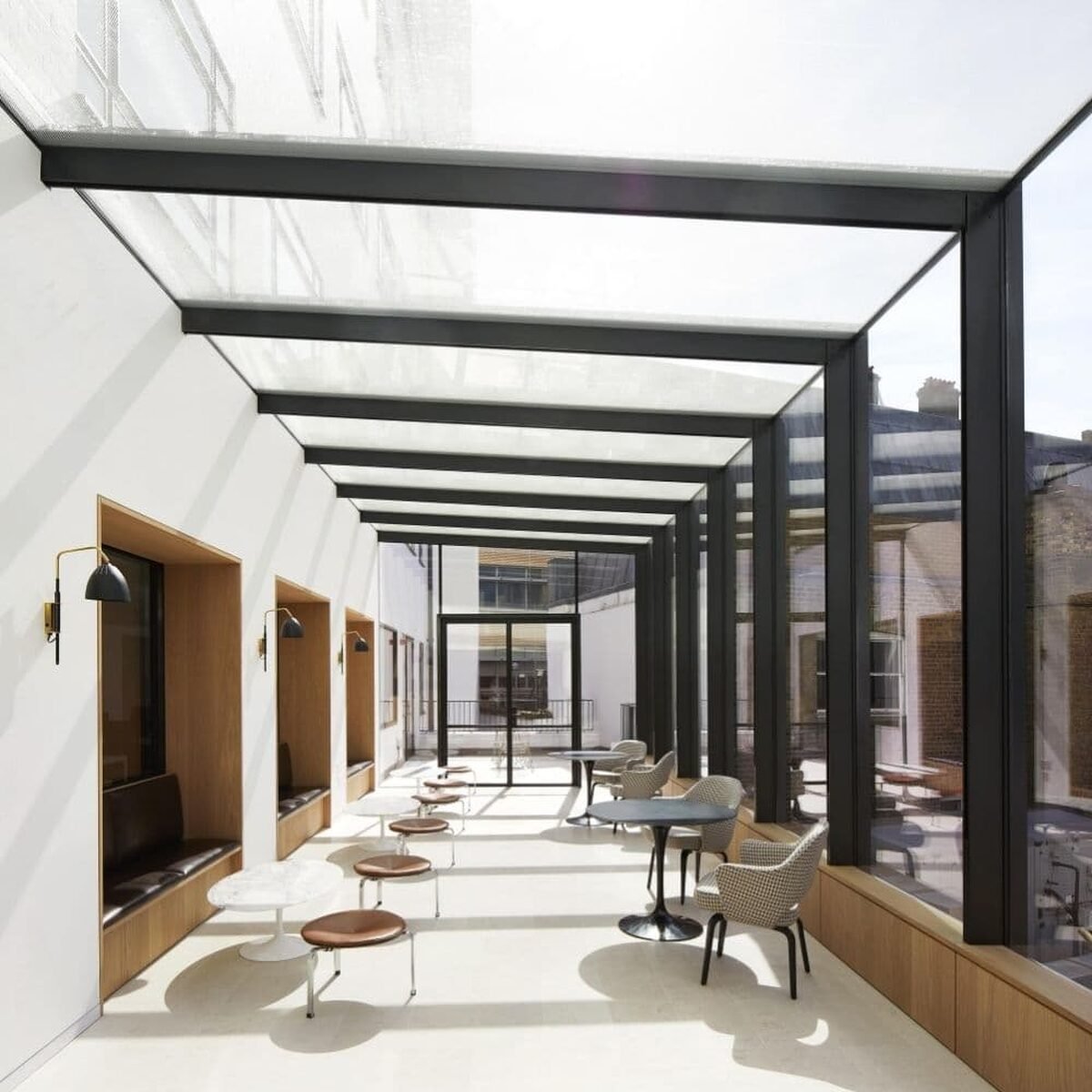
South and west-facing glazing takes the brunt of summer solar gain — low afternoon sun angles straight through vertical glass, and roof glazing sits under near-overhead sun for most of the day. Without solar control, large glazed areas on these elevations routinely push rooms into uncomfortable overheating by mid-afternoon, even with good ventilation. Cutting the g-value from a clear-float baseline of around 0.83 down to 0.25-0.40 removes the majority of that incoming heat before it reaches the room, while the glass still reads as clear or near-clear from both sides.
See how the coating rejects summer heat before it enters:
Understanding Selectivity
Selectivity is simply light transmission divided by g-value — it tells you how much daylight you keep for every unit of heat you reject. A product with high light transmission and a low g-value has high selectivity: it lets the room stay bright without also letting it get hot. Two glasses can share the same g-value but feel very different to sit under — the one with the higher selectivity keeps more daylight for the same heat rejection.
Solar Control or Tinted Glass?
Choose solar control where heat rejection is the priority and a neutral, near-clear appearance matters — most south/west windows and roof glazing. Choose tinted glass where the look of the glass itself is the priority — a distinct bronze, grey or green tone — with some heat and glare reduction as a welcome side effect rather than the main goal. Both can be paired with Low-E in the same sealed unit for winter thermal performance alongside summer heat control.
Related Products & Glass Types
Get a Trade Quote
Contact our sales team — most quotes returned within 2 hours.