
Float Glass
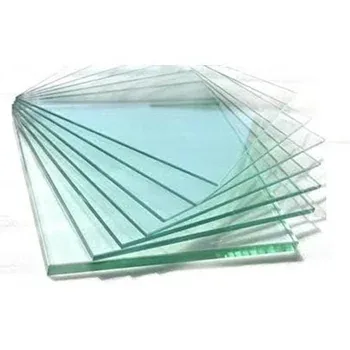
Standard annealed soda-lime-silicate glass — the base substrate for all glazing products. Manufactured by floating molten glass on molten tin. Every other glass type starts as float glass before further processing.
Float Glass — The Foundation
Float glass is manufactured by floating molten glass (at approximately 1,100°C) on a bath of molten tin, producing perfectly flat, distortion-free sheets with uniform thickness and optically clear surfaces. The process was invented by Sir Alastair Pilkington in 1959 and is used worldwide. Every other glass type — toughened, laminated, Low-E coated, solar control, self-cleaning, fire-rated — starts as float glass before further processing.
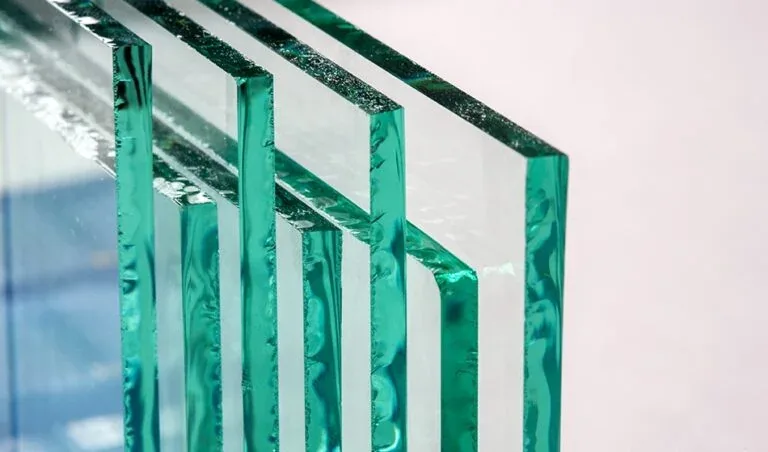
Standard clear float has a slight green tint visible at edges due to iron oxide content (~0.10% Fe₂O₃). For applications where colour-neutral edges are important, use low-iron glass (Pilkington Optiwhite, SGG Diamant) which reduces iron to ≤0.01%.
The float-bath process from furnace to cut sheet:
Brand Names
| Manufacturer | Product | HQ |
|---|---|---|
| Pilkington (NSG) | Optifloat Clear | St Helens, UK |
| Saint-Gobain | Planiclear | Paris, France |
| Guardian | Guardian Clear | Michigan, USA |
| AGC | Planibel Clear | Brussels, Belgium |
Performance in Sealed Units
| Configuration | U-Value | Light | g-value | Weight/m² |
|---|---|---|---|---|
| 4mm single pane | 5.8 | 90% | 0.87 | 10 kg |
| 4-16-4 Air DGU | 2.8 | 82% | 0.76 | 20 kg |
| 4-16-4 Low-E Argon | 1.1 | 80% | 0.63 | 20 kg |
| 4-20-4 Low-E WE Argon ★ | 0.9 | 80% | 0.63 | 20 kg |
Glass Weight per Thickness
Glass density: 2,500 kg/m³. Weight = Thickness (mm) × 2.5 × Area (m²).
| Thickness | Weight/m² | 600×900 | 1000×1200 | 1500×2000 | Max Sheet | Toughening | Laminating |
|---|---|---|---|---|---|---|---|
| 4mm | 10 kg | 5.4 kg | 12 kg | 30 kg | 3210×2500 | Yes | Yes |
| 6mm | 15 kg | 8.1 kg | 18 kg | 45 kg | 3210×2500 | Yes | Yes |
| 8mm | 20 kg | 10.8 kg | 24 kg | 60 kg | 3210×2500 | Yes | Yes |
| 10mm | 25 kg | 13.5 kg | 30 kg | 75 kg | 3210×2500 | Yes | Yes |
| 12mm | 30 kg | 16.2 kg | 36 kg | 90 kg | 2800×2000 | Yes | Yes |
| 15mm | 37.5 kg | 20.3 kg | 45 kg | 112.5 kg | 2400×1500 | Yes | Yes |
| 19mm | 47.5 kg | 25.7 kg | 57 kg | 142.5 kg | 2000×1200 | Yes | Yes |
Limitations
- NOT safety glass: Breaks into sharp shards. Use toughened/laminated for safety locations.
- Poor thermal single: U-value 5.8. Must be in sealed unit with Low-E.
- Thermal stress risk: Prone to fracture if partially shaded. Toughen large panes.
- Green edge tint: Use low-iron (Optiwhite) where colour-neutral edges needed.
Related Products & Glass Types
Get a Trade Quote
Contact our sales team — most quotes returned within 2 hours.